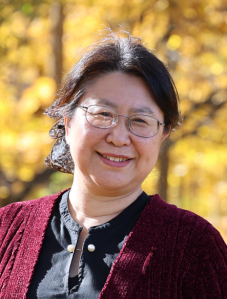
Ying “Lucy” Zhou, Ph.D. Founder & President Hinsdale Multicultural Arts & Education Association (HMAE)
Building Bridges. Creating Belonging.
For Lucy, “building bridges” is both literal and figurative. Before moving to the United States, she spent ten years in higher education in the field of bridge engineering in China. She was a columnist for the “Bridge Culture” column in the A4 Overseas Edition of China Transport News, a member of the Guangdong Provincial Bridge Expert Pool, and a contributing writer for Bridge magazine. Before leaving China, she served as an associate professor in bridge engineering at the School of Transportation, South China University of Technology, where she supervised master’s students, served as a co-supervisor for doctoral students, and directed the bridge engineering program. Today, she is still building bridges—only now, instead of connecting the two ends of a physical bridge, she connects people across ethnicities, cultures, generations, and communities.
Building Bridges — Literally and Figuratively
Lucy’s undergraduate and master’s degrees were in Engineering Mechanics, and her Ph.D. was in Bridge Engineering. Her postdoctoral research focused on finite element analysis of underground structures for pumped-storage power stations using ANSYS. She later worked at Guangzhou University and South China University of Technology in bridge engineering education, research, engineering practice, and professional training. During a transition between academic positions, she also held technical consulting leadership roles at two private companies. In addition to teaching 13 professional courses, she was responsible for the annual review of undergraduate and master’s curricula and course arrangements.
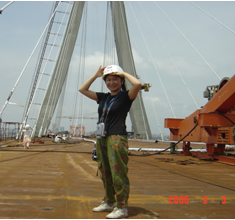
Lucy at a bridge construction site in China, 2006.
Lucy’s interest in the structure of a curriculum began when she was a student. She was rarely satisfied with learning the content of a single lesson or chapter in isolation. Instead, she tended to ask how different ideas were connected, why one topic came before another, how chapters related to one another, and what larger structure held the knowledge together. After completing a unit, she often mapped the relationships among its key concepts in the form of a network diagram, making the connections among different ideas clearly visible. She later brought this way of understanding knowledge into her own teaching.
She also liked to teach through a principle of “framework and freedom”—first establishing a clear structure for a subject, then giving students substantial freedom within that structure. For example, in elective courses she often used open-book examinations in which students designed their own exam questions, provided the answers, and explained what knowledge each question was intended to test, where misunderstandings might arise, and why the question was worth asking. She also founded a Bridge Salon for master’s students at South China University of Technology, creating a space for students to continue exploring bridge-related topics through discussion outside the formal curriculum. These experiences gradually shaped a principle that would continue through her later teaching and community work: clear and strong structure does not limit thinking; rather, it creates the conditions for deeper thinking, independence, and creativity.
Lucy also wrote the “Bridge Culture” column for China Transport News. These popular-science articles introduced notable bridges from around the world, combining engineering knowledge with extensive research, history, culture, and storytelling. She wanted the articles not only to be interesting to general readers, but also to offer technical information and different perspectives to professionals in the field. This experience developed a skill that later became especially important in her work in the United States: breaking down complex professional knowledge into layers, making it more engaging, and helping audiences with different backgrounds understand the parts most relevant and interesting to them—and come away with something meaningful.
Building a Chinese Learning System in the U.S.
After moving to the United States, Lucy spent more than a decade teaching and tutoring children and teenagers. As she worked with young learners, she became increasingly aware that many Chinese-language materials had been developed for students living in China and did not fully reflect the language environment, daily life, or learning needs of children growing up in the United States.
Drawing on her background in curriculum design, Lucy gradually developed her own structured Chinese-language learning system for students growing up outside China. Her students have included heritage Chinese learners, children from multiracial families, and students from families with no Asian background.
The system emphasizes pinyin as a tool for independent learning and gives each lesson a clear, consistent progression—from Chinese-language routines and attention to the child’s emotional and physical readiness, through review, independent learning, teacher guidance, and assessment, to a closing music activity. Within this structure, instruction is adapted to each child’s individual needs, pace, and readiness.
Lucy’s guiding principle is simple:
Structure does not limit personalization; it makes thoughtful personalization possible.
Her goal is not simply to help students complete a textbook, but to help them understand how to learn, develop confidence, and eventually become more independent learners.
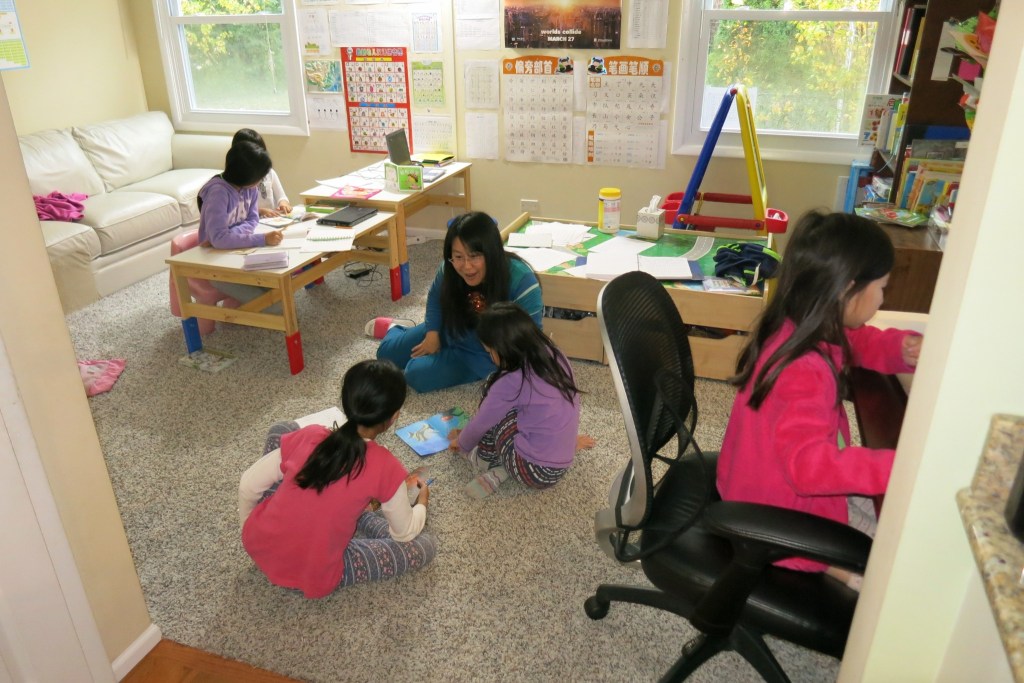
Lucy working with young learners in her Chinese-language program, where structured learning is adapted to individual needs, 2015.
Family & Youth Education
Lucy’s interest in family and youth education began in China. With limited time available for parenting, she used everyday family learning activities to help her daughter develop habits of reading, storytelling, self-expression, and early writing, gradually becoming a more independent learner and communicator.
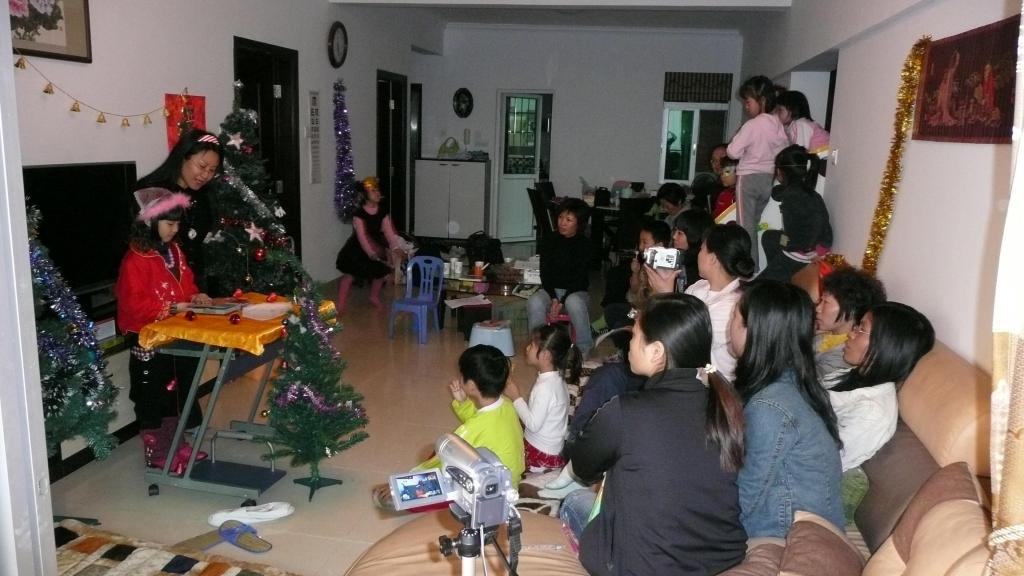
She later organized ten small reading and performance gatherings in her home. Children prepared something they wanted to read, tell, or perform, shared it with the group, and then voted together on what to rehearse and present that day. Through these gatherings, Lucy also began developing practical principles for managing youth enrichment groups: keep the group small enough for every child to participate meaningfully; provide structure while leaving room for creativity; and make the learning experience engaging enough that children and families want to return again and again.
Lucy and her daughter at an early family reading and performance gathering in China, where children practiced reading, storytelling, and presenting in front of others, 2007.
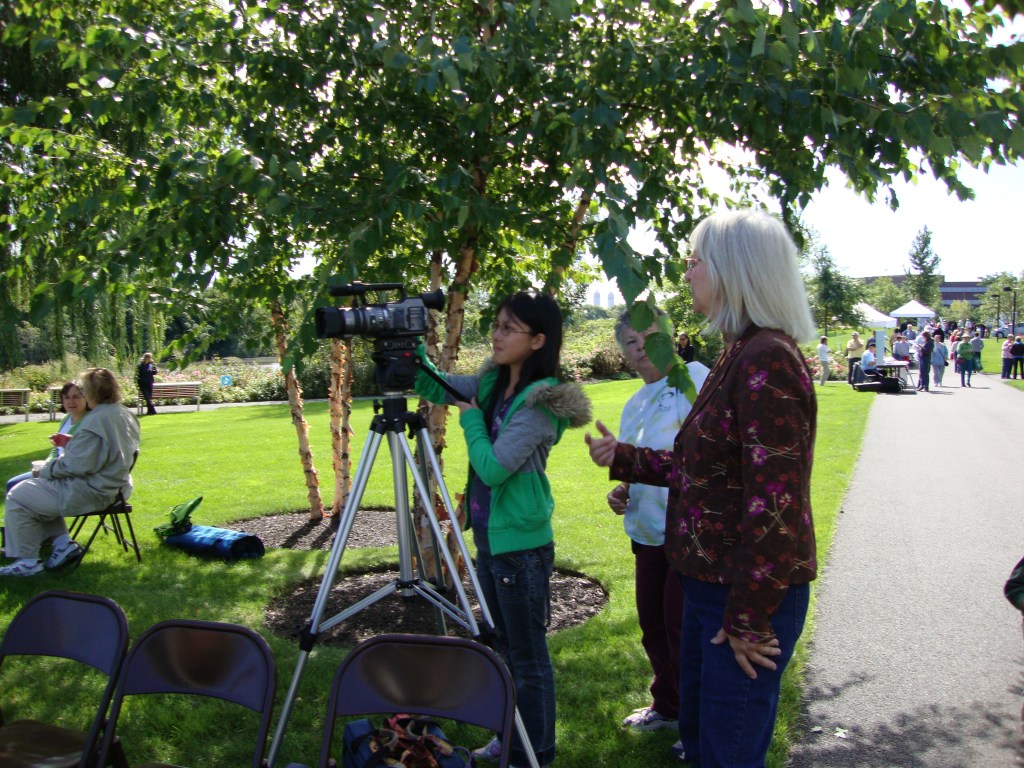
After moving to the Boston area, Lucy helped create the SALSA Kids Video Club. The name SALSA came from the initials of the five original young participants. The club was a youth media project that regularly produced programs for the local community television station, MATV. The children wrote their own content, performed, filmed, and learned production and post-production editing, while Lucy provided extensive behind-the-scenes organization and coordination, steadily moving the project forward and helping the group turn ideas into programs ready for broadcast. Her daughter was especially passionate about the project and helped lead the other young participants in sustaining the demanding schedule of producing a new half-hour program each month.
Lucy’s daughter recording a community event as part of the SALSA Kids Video Club’s work with local community television in the Boston area, 2011.
After settling in the Hinsdale area, and as her two children grew older, Lucy created and organized a wider range of community groups for young people, parents, and families to participate in together. In 2015, she started a parent WeChat group called “Let’s Talk Education.” The group grew from just over 30 members to more than 100, including local families as well as their relatives and friends in both the United States and China. During its most active years, the group discussed virtually every aspect of family education they could think of and also held several large in-person gatherings.
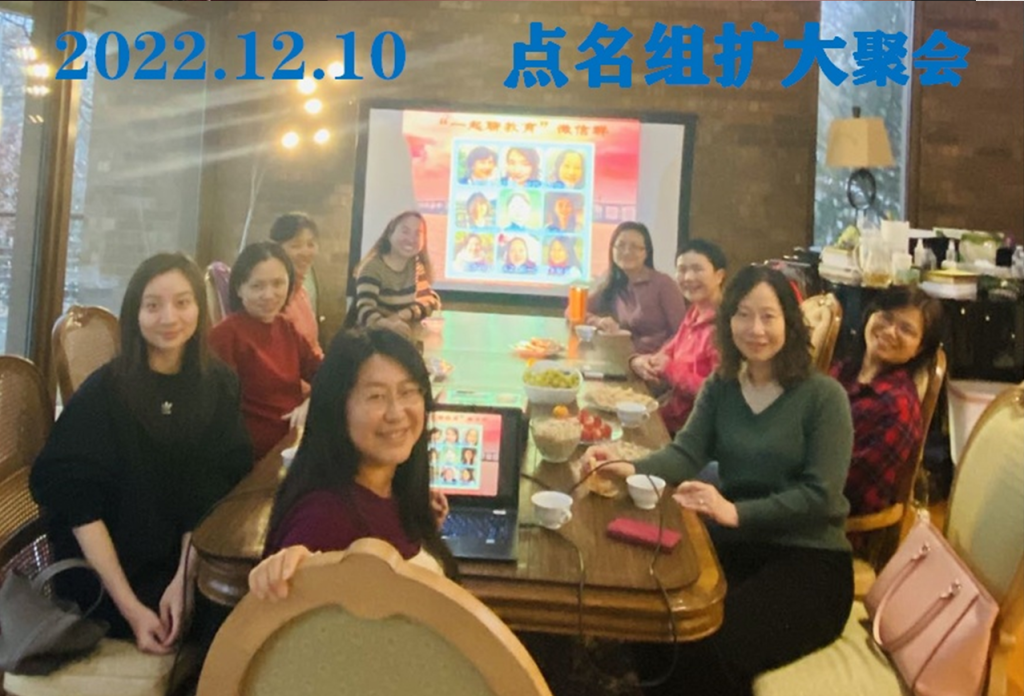
A nine-member core group continued meeting regularly in person through the end of 2022, exploring new questions that emerged as technology advanced and their children grew older. Through this process, Lucy gradually organized her thinking on family education into a structured series of 12 topics, which she and her friends shared through annual conferences and community lectures. By 2025, all 12 video lectures in the “Family Education and Adolescent Mental Health” series had been uploaded online.
Lucy with participants at an expanded parent education gathering, where she gave a presentation followed by group discussion, 2022.
Communication and self-expression have always been central to Lucy’s work in youth education. In addition to teaching Chinese, she has long trained students in storytelling and writing. She sees the two as complementary forms of “output”: one spoken, the other written. She consistently encourages young people not only to absorb information, but also to express their ideas clearly, confidently, and thoughtfully.
One example was a practice Lucy called “telling a journal.” When her children were about five and not yet able to write independently, she encouraged them to tell a journal entry aloud each day whenever possible, while she typed and saved their words. She posted some of these entries on Sina Blog so that relatives and friends in different places could leave encouraging comments for the children. As they gradually learned pinyin, character recognition, keyboard input, and how to publish blog posts themselves, Lucy slowly stepped back.
At first, Lucy taught them to choose a clear topic before telling a journal entry or writing a story and to organize their ideas using a simple five-part structure. Once that framework was in place, the children had plenty of room within each section to use their imagination and creativity. As the first reader of their journals, Lucy strongly emphasized encouragement over correction. Preserving the child’s desire to express themselves mattered more than anything else, and these practices often continued through the high school years. She later developed these experiences into introductory writing, writing-structure, and storytelling courses.
Before the COVID-19 pandemic, Lucy also worked with other parents to organize four or five large gatherings each year, often bringing together 50 to 60 people. After a shared meal, children and families performed through music, dance, storytelling, skits, magic, or any other form they enjoyed. These informal but long-running gatherings created regular opportunities for children to become more comfortable expressing themselves in front of others. Across the youth programs Lucy led, her focus was never limited to any single skill, but on the broader capacities young people need to move from participation, to collaboration, and eventually to taking on leadership responsibilities.
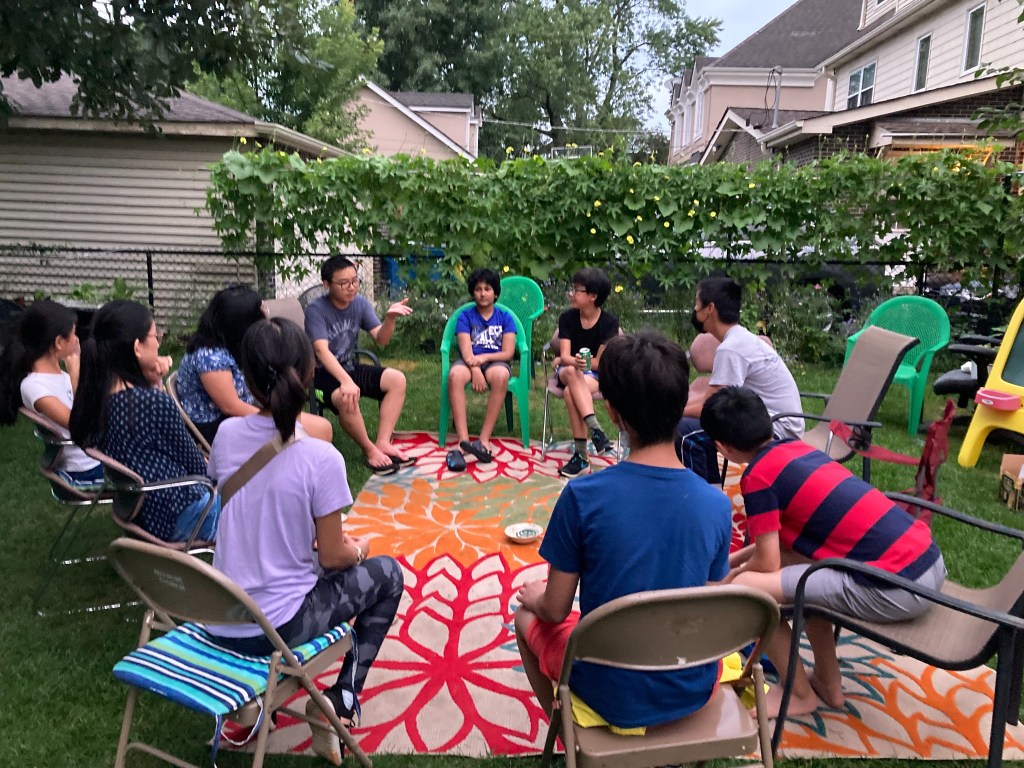
In 2016, Lucy’s daughter created the SALSA “Read, Write, Think” Club for middle school students, commonly referred to as the SALSA Reading Club, carrying forward the SALSA name from the earlier SALSA Kids Video Club. After the COVID-19 pandemic, Lucy took over the club and expanded its original emphasis on reading, writing, and thinking to include public speaking and debate. She also continued mentoring a student leadership team made up of students from different grade levels until they were gradually able to lead group activities with greater independence. For about a year, SALSA students also helped support a youth book club at Hinsdale Public Library, extending their participation beyond the group itself into the wider community.
These experiences further strengthened an important principle in Lucy’s work with young people: young people first need a sense of belonging, then opportunities to collaborate, and only over time do they develop the confidence and ability to lead others. She has been especially committed to creating repeated opportunities for children who may not otherwise be the first to be chosen in school or community activities—places where they can participate, contribute, take on responsibility, and gradually practice leadership. Lucy believes that many young people do not lack ability; what they often lack is a place to begin, a chance to practice, and the opportunity to discover, “I can do this too.”
Students in Lucy’s SALSA reading and discussion club, where reading, critical thinking, public speaking, debate, and student leadership were developed together, 2022.
From Ideas to Public Projects
Lucy has always encouraged young people to take on passion projects that require sustained commitment, resilience, teamwork, and leadership. She helps them turn ambitious ideas into completed public projects.
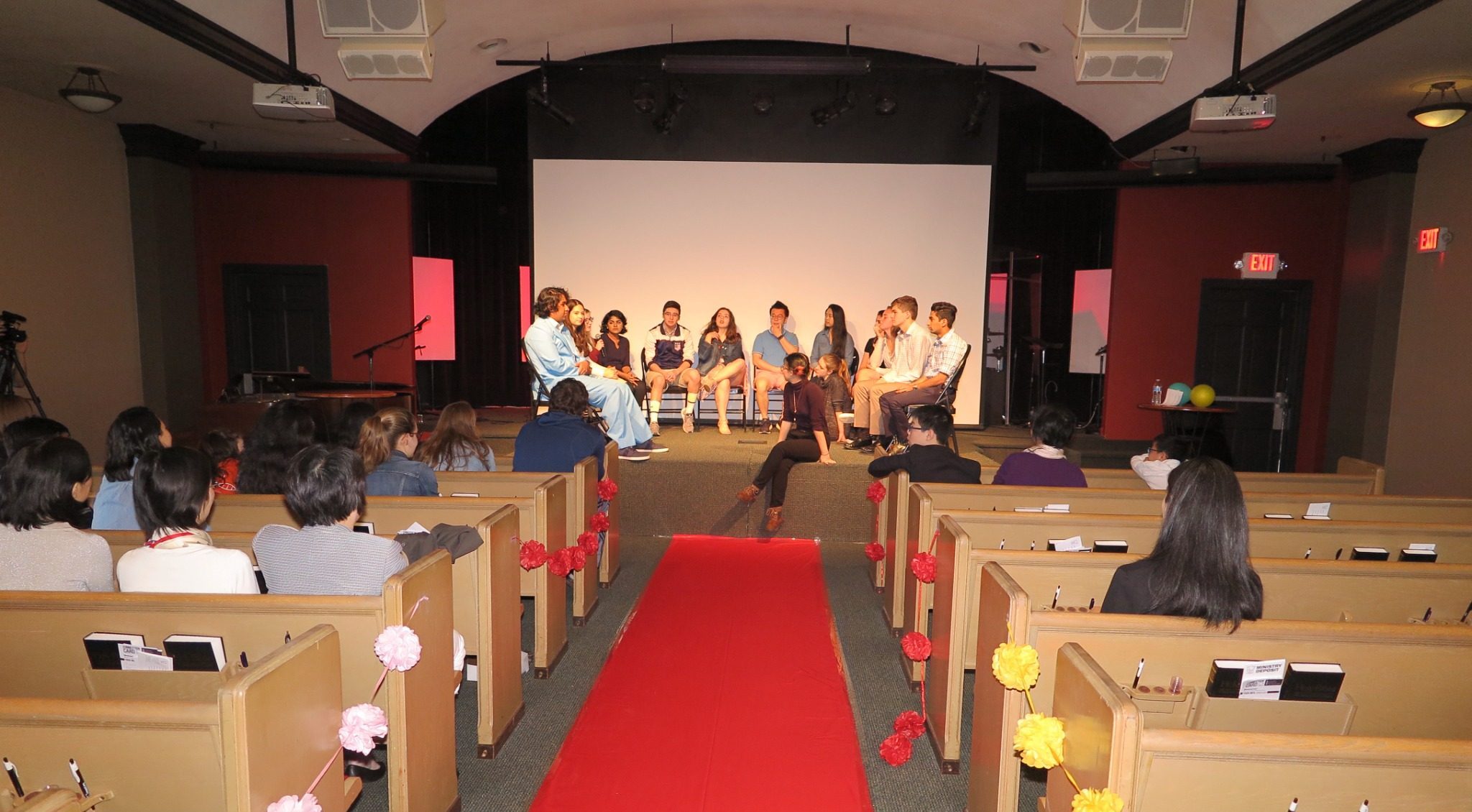
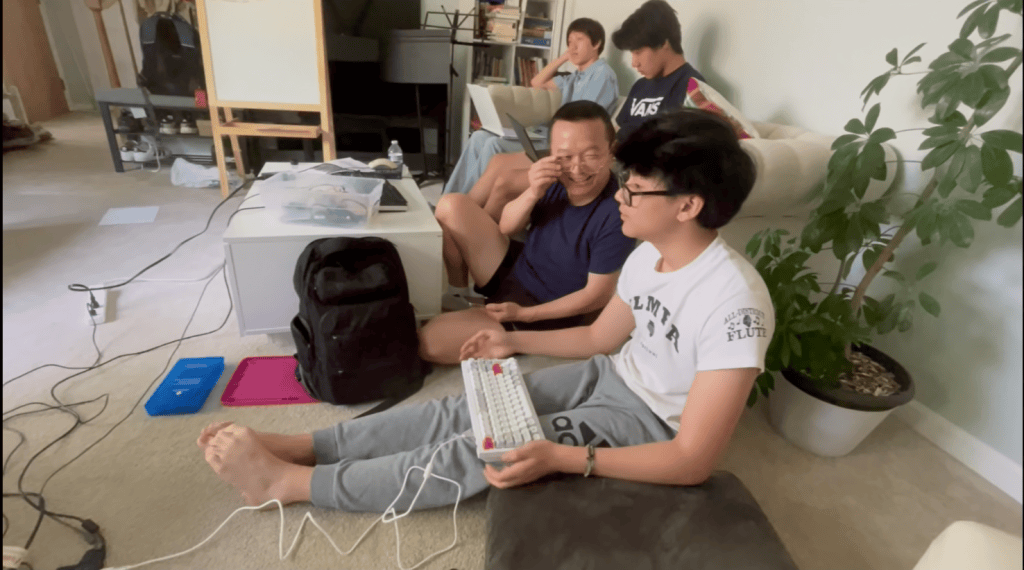
One example was The Applicants (21 College Applicants), a nearly two-hour documentary independently produced by her daughter. The film featured interviews with 21 college applicants, ultimately involved about 200 hours of work, and concluded with a large community premiere. Another was an LED Tetris game board and LED electronic clock developed by her son and two teammates. Lucy helped the students build confidence, find mentors, purchase materials, coordinate schedules and transportation, organize a parent support team, and ultimately present the finished projects in the community and produce a promotional video.
Community premiere of The Applicants, followed by a participant discussion, 2018.
Development work on the LED Tetris project with a technical coach, 2025.
These projects reflect another important principle in Lucy’s approach to youth education: helping young people begin with an idea, move through sustained effort, collaboration, and completion, and ultimately use what they create to serve the community.
Over the years, the long-term learning groups Lucy organized or led have included an eight-year storytelling group that met exactly 300 times, a two-year science group, a seven-year SALSA reading club, and a Bible story group that held 107 discussions over two and a half years. Although these groups took different forms, they consistently emphasized reading, writing, and communication, while also developing critical and independent thinking, imagination and creativity, teamwork and leadership, and ultimately connecting learning with community service.
Through these experiences, Lucy came to believe that the most effective learning groups are not necessarily the largest, but those sustained by families willing to participate over time, support one another, and grow together. She also saw that confidence and leadership do not emerge all at once; they develop gradually through repeated practice and increasing responsibility.
In the storytelling group, children prepared short stories at home, presented them to the group, and practiced interactive skills such as asking and answering questions, week after week. In the Bible story group, after teaching the group herself for about six months, Lucy began helping older students take on the role of “young teachers,” while she coached them behind the scenes in lesson preparation, teaching, communication, and leadership. Again and again, Lucy saw the same pattern of growth: children first participate, then begin to contribute, and only gradually develop the confidence and leadership to move on to larger platforms.
From Events to Community Traditions
Since 2023, Lucy has initiated and helped build a series of recurring multicultural celebrations in the greater Hinsdale community.
Lucy speaking at a community cultural celebration at Hinsdale Public Library, 2026.
Mid-Autumn Festival and Lunar New Year celebrations began at Hinsdale Public Library and continued year after year, with Lunar New Year later expanding to Hinsdale Central High School and Hinsdale Covenant Church. The library’s Lunar New Year celebration is now approaching its fifth annual event.
In 2026, HMAE organized an Asian American, Native Hawaiian, and Pacific Islander (AANHPI) celebration in partnership with HAA, which served as the host. The program created a new collaboration between the two organizations and has already been included in HAA’s 2027 calendar.
Lucy has also helped bring multicultural participation into Hinsdale’s broader civic life. In 2025 and again in 2026, she organized a multicultural community group to take part in Hinsdale’s Independence Day parade through the local Lunar New Year celebration committee.
Lucy’s goal has never been simply to organize one successful event. She has worked to help new celebrations become lasting community traditions—events that people begin to expect, recognize, and pass forward from year to year.
The Mid-Autumn Festival has received growing civic recognition. In 2025, the Village of Hinsdale proclaimed October “Mid-Autumn Moon Festival Month.” In 2026, the celebration became part of Hinsdale’s America 250 programming.
Community Storytelling Through Video
Lucy has also used short-form video as a tool for cultural education, community storytelling, and preserving community memory. Before the first Mid-Autumn Festival and Lunar New Year celebrations, she created short videos introducing the origins and customs of the holidays; after the events, she produced photo and video highlights to document the celebrations.
One of her largest projects was a community video created to promote the 2025 Lunar New Year celebration. Lucy invited more than 100 individuals and community groups to record short video messages, asking them to reflect on past events and share what they would participate in, prepare, or look forward to in the coming celebration. Working with more than two hours of submitted footage, she ultimately edited the material into an approximately nine-minute bilingual video featuring elected officials, library and school leaders, clergy, students, teachers, parents, alumni, performers, volunteers, local residents and businesses, as well as community organizations.
Looking back, the project became far more than an event-promotion video. It became a shared record of community memory—capturing how a community came together around an emerging cultural tradition.
More Than a Celebration: A Community Tells Its Story
More than 100 individuals and community groups contributed their voices to this collaborative community video, 2025.
Cross-Cultural Education & Civic Service
Cross-cultural education has also been a long-running thread in Lucy’s work. She has intentionally given her own children firsthand experience in different cultural and educational environments. Before the COVID-19 pandemic, her son returned to China with the family almost every year beginning around age three, briefly participating in activities at both public and private preschools and, in fourth grade, spending a week in a Chinese elementary school. During these visits, Lucy also returned to her own former school on multiple occasions to speak with students across the school or in individual classrooms, emphasizing the importance of extensive reading and writing.
In 2016, she first visited her daughter’s high school East Asian history class to discuss cultural differences between China and the United States. Ten years later, in 2026, she was invited back to speak with two classes. This time, the discussion moved beyond simply asking how Chinese and American cultures differ to exploring what lies behind those differences, and how young people’s experiences, values, and perspectives have changed over the past decade as the world itself has changed rapidly. The teacher later expressed interest in developing the program into an annual part of the course.
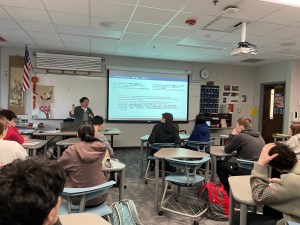
Lucy speaking with students at her former school in China during a return visit, 2019.
Lucy speaking to a high school East Asian history class, 2026.
Lucy has also developed a wide range of carefully researched cultural education programs for the community. At the first Lunar New Year celebration at Hinsdale Public Library, she combined the celebration with a cultural presentation that explored the symbolism behind holiday customs and introduced some lesser-known details, adapting the content for different audiences.
She later developed tea culture programs at Hinsdale Public Library and Wellness House, and expanded this work into the Eastern Culture Series, designed as an in-person learning experience for the AI era. The series emphasizes several key features: evidence-informed content, hands-on participation, interactive sharing, live performance, and opportunities for participants to take something they created or learned home with them.
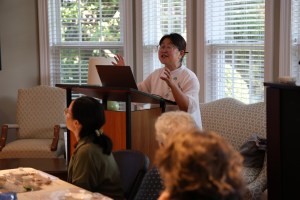
Lucy presenting a cultural education program at Wellness House, 2026.
School-Related Service
During her first year in the United States, just one month after her daughter started school in the greater Boston area, Lucy began getting involved in community service. She volunteered regularly in her daughter’s school library and later completed training with a local community television station, where she helped film community events. For Lucy, volunteering was both a way to contribute and a way to learn.
She has also supported youth music in the Hinsdale area in a variety of ways. She helped launch the Red Dragon Music Band and, together with her husband, has provided extensive behind-the-scenes support over the years. Beginning in 2026, Lucy also helped the band extend its reach beyond the local community by participating in charitable events and programs organized by regional Chinese community associations.
Lucy has also long supported the Hinsdale Central High School music community. She served as a band parent liaison with the Music Boosters and took responsibility for creating and managing the Boosters’ electronic monthly newsletter and social media presence. These efforts strengthened communication between the school and families while also increasing the visibility of student music activities in the broader community.
Faith-Related Service
Lucy’s community service has also extended to local churches. During her years at The Chapel in Hinsdale, she served on the technical team. After joining Hinsdale Covenant Church, she began serving in Sunday school and on the Greeting Team. Since 2021, Lucy has also led a Friday evening reading and discussion group that explores questions related to the meaning of life.
Library-Related Service
Lucy’s connection with Hinsdale Public Library began with family and community gatherings held there and gradually expanded into free public education programs, including teaching children Chinese songs, telling Chinese stories, and organizing reading-and-performance activities, as well as a variety of multicultural programs. Over time, the library became an important setting for her community education and cultural work.
After more than two years of sustained advocacy and coordination, Lucy helped establish a free ESL learning program for older adults in the community. She also helped seniors build stronger social connections through gatherings, information about community resources, and cultural activities. She invited them to take active roles in the multicultural celebrations she organized, including crafts, calligraphy, food, tea demonstrations, and performances, and helped this group develop into the HMAE Senior Program.
From 2023 to 2025, Lucy served as an elected Hinsdale Public Library Trustee and Board Secretary. This experience added a new dimension to her community work and gave her firsthand insight into local public service, institutional governance, and the role public libraries can play in connecting communities.
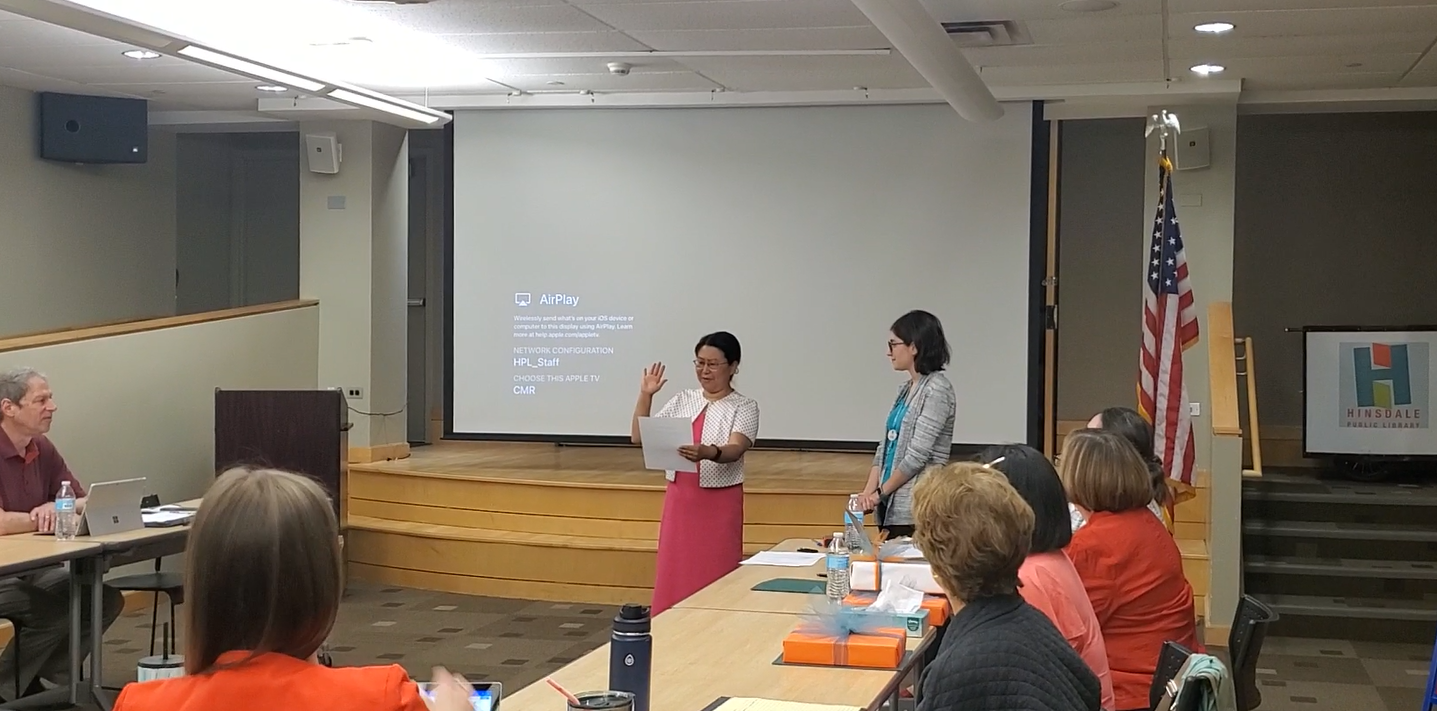
Lucy being sworn in as a trustee of the Hinsdale Public Library Board, 2023.
A Family-Centered Journey of Continued Growth
Much of Lucy’s work in the United States gradually grew out of the years when she was a stay-at-home mother. That season gave her the opportunity to bring abilities developed in her earlier professional life—systems thinking, curriculum design, scientific research, technical skills, and project coordination—directly into family life. These abilities gave her children access to a different range of experiences, opportunities, and sustained family support. Rather than expecting them to manage every part of a complex project independently from the beginning, Lucy provided time, structure, encouragement, and extensive behind-the-scenes support so that they could first get started, then practice repeatedly, gradually take on greater responsibility, and eventually become more independent.
Lucy did not view those years as a “pause” in her professional growth. Instead, she used the relative flexibility of that stage of life to continue learning, serving, and actively engaging whenever new opportunities arose. Among the outcomes she values most are a structured Chinese-language teaching system, a 12-part series on family education and adolescent mental health, and multicultural celebrations that are gradually becoming long-term community traditions. What began as individual acts of teaching, volunteering, and community participation gradually grew into systems, series, and traditions.
The ideas had been developing for years; Hinsdale gave them time to take root.
Today: HMAE
HMAE brings together many of the threads that have shaped Lucy’s work for decades: curriculum design, public education, writing, cultural interpretation, youth development, civic engagement, and community building.
Through HMAE, she continues to develop multicultural celebrations, educational programs, community partnerships, and opportunities for people of different backgrounds and generations to learn from one another.
Building Bridges. Creating Belonging.
For Lucy, the bridge has changed—but the work of connecting people continues.

 Hinsdale Multicultural Arts & Education Association (HMAE)